Category Archives: Uncategorized
New graduate student Josh Reynolds
Josh Reynolds has joined the group as a new graduate student. Welcome, Josh!
Posted in Uncategorized
Comments Off on New graduate student Josh Reynolds
Dana & Sritin at UCSD
Purse Lab members Dana Rosansky and Sritin Ghosh are starting their year of coursework at UCSD as a part of the SDSU–UCSD Joint Doctoral Program in Chemistry. It’ll be a busy year for them both! If you’re interested in being … Continue reading
Posted in Uncategorized
Comments Off on Dana & Sritin at UCSD
Fluorescent metabolic labeling of RNA for live-cell imaging
Ani Shalamberidze, a Ph.D. student member of our team, has published a JACS paper in collaboration with the Kleiner Lab at Princeton shows that a combination of judiciously selected fluorescent nucleoside analogues with genetic upregulation of nucleoside kinase activity enables metabolic labeling and live-cell … Continue reading
Posted in Uncategorized
Comments Off on Fluorescent metabolic labeling of RNA for live-cell imaging
New manuscript on bioRxiv
Purse Lab Ph.D. student Ani Shalamberidze is working in collaboration with the Kleiner Lab at Princeton University on a new method for metabolic labeling and live-cell imaging of RNA. We have found that the right design of fluorescent ribonucleoside analogue … Continue reading
Posted in Uncategorized
Comments Off on New manuscript on bioRxiv
Single molecule fluorescence detection of a nucleoside analogue
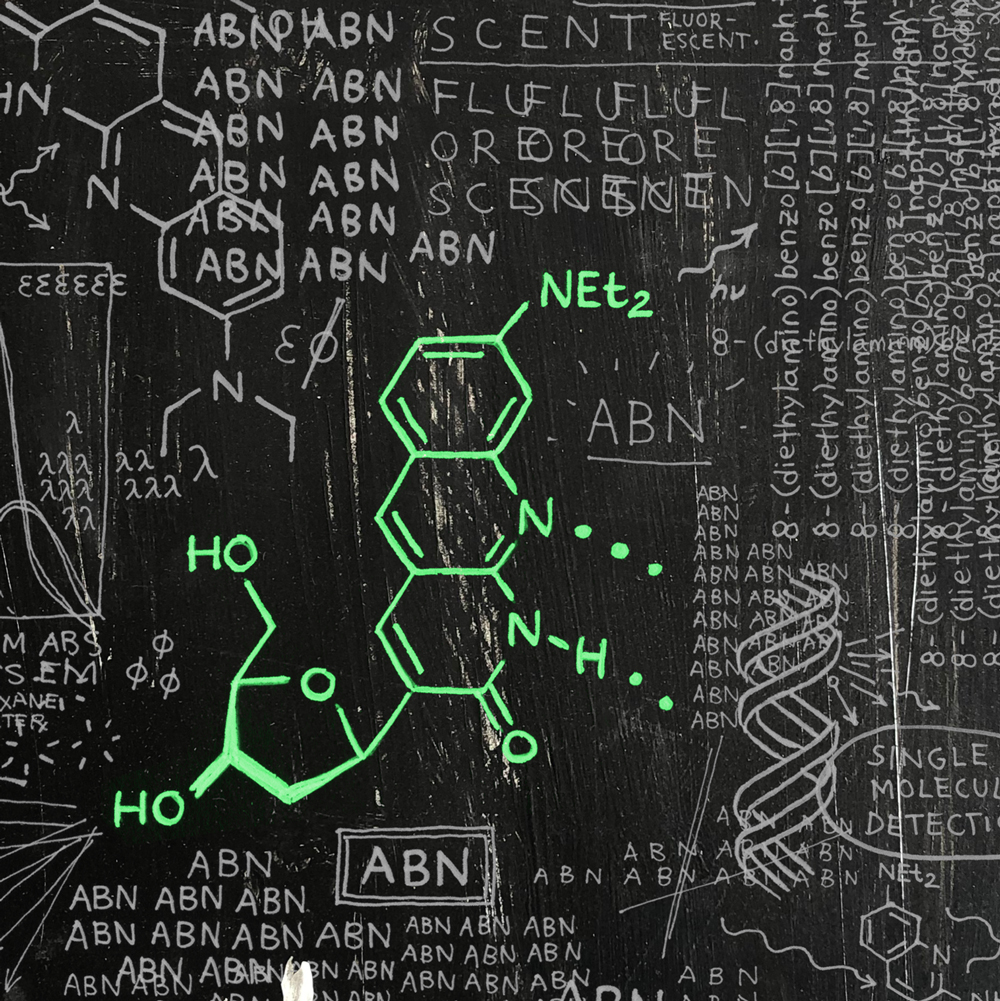
Congrats to George Samaan for his first authorship of our new publication, Single-molecule fluorescence detection of a tricyclic nucleoside analogue, just out in Chemical Science! Along with undergrads Mckenzie Wyllie and Julian Cizmic, George created this molecule, informed in part … Continue reading
Posted in Uncategorized
Comments Off on Single molecule fluorescence detection of a nucleoside analogue
Ben Turner’s Research is Highlighted in ChemistryViews
ChemistryViews, the online magazine of Chemistry Europe, has just published a highlight of Ben Turner’s new research article describing the use of fluorescent nucleotide substrate analogues for retroviral reverse transcriptases! Check out their coverage of Ben’s research! <http://www.chemistryviews.org/details/ezine/11242991/Reverse_Transcription_Used_to_Generate_Fluorescent_DNA.html>
Posted in Uncategorized
Comments Off on Ben Turner’s Research is Highlighted in ChemistryViews
Welcome to Dana Rosansky!
Dana Rosansky is joining the Purse Lab, fresh after finishing her B.A. in Biochemistry from the University of San Diego. Dana worked with Prof. Tammy Dwyer at USD on NMR studies on the structure of chemically modified DNA. Now she’s … Continue reading
Posted in Uncategorized
Comments Off on Welcome to Dana Rosansky!
New Paper: Fluorescent Labeling in Reverse Transcription
Congratulations to Ben Turner on his new paper that’s just out in ChemPlusChem! Ben’s results show that fluorescent tricyclic cytidine analogues tC and DEAtC are substrates for retroviral reverse transcriptases. They can be used by these enzymes to synthesize fluorescently … Continue reading
Posted in Uncategorized
Comments Off on New Paper: Fluorescent Labeling in Reverse Transcription
George’s 1st First-Author Paper is Published!
Congratulations to George Samaan for his 1st first-author paper, just published in Bioorg. Med. Chem. Lett.! Our new study shows that structure-guided inhibitor design can be used to prepare new 8-oxo-G analogues as GTP cyclohydrolase inhibitors with the potential to … Continue reading
Posted in Uncategorized
Comments Off on George’s 1st First-Author Paper is Published!
The Purse Lab Against Zika
Today we published a new paper on our efforts to combat the Zika virus. Lead authors Jean Bernatchez of UCSD and Michael Coste (from the Purse Lab at SDSU) have shown that the activity of Zika inhibitors synthesized by Michael … Continue reading
Posted in Uncategorized
Comments Off on The Purse Lab Against Zika